
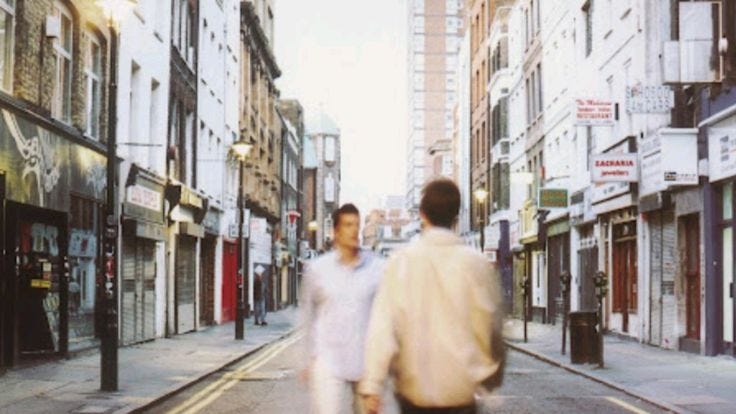
Someone once asked me, "Who is your wonderwall?"
It’s a question most people answer with a name. We are culturally conditioned to believe that a wonderwall must be a person—a romantic partner, a flesh-and-blood mentor, or a lifelong best friend. We are told that to be saved, we must anchor our souls to someone else.
But what happens when your world goes quiet? What happens when there is no one standing within your immediate radius to look up to, no hand to hold, and no human presence filling the empty spaces of your room?
If you ask me, my wonderwall isn't a person at all. Mine belongs to the wonders of art and music.When Noel Gallagher penned the lyrics to Oasis’s generation-defining anthem, he famously resisted the romanticized narrative. He didn't describe a "wonderwall" as a lover, but rather as an "imaginary friend who’s gonna come and save you from yourself."
But what happens when your world is quiet? What happens when there is no one in your immediate radius to look up to, no hand to hold, and no person filling that space?
My wonderwall comes from art and music.
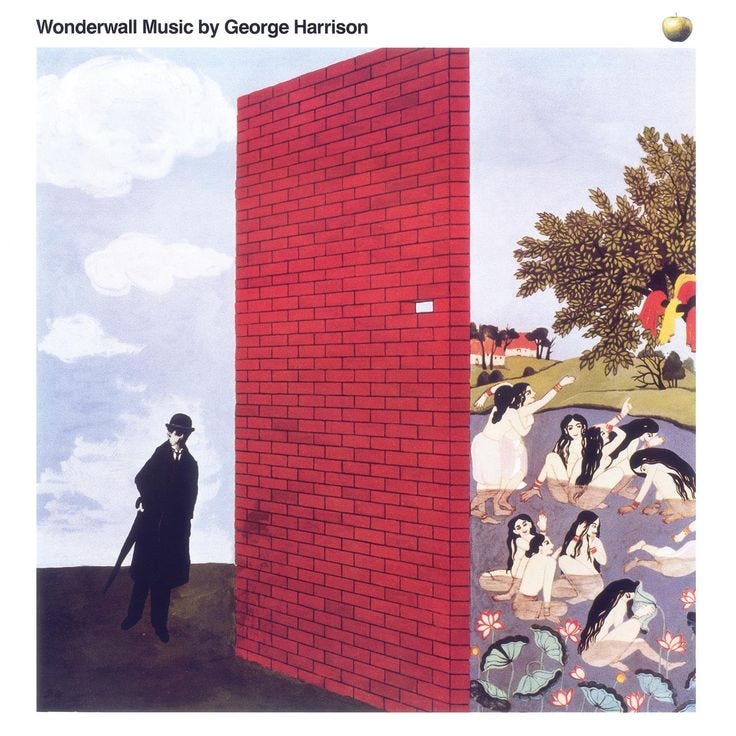
Yet, the etymology of the word goes even deeper, stretching back to a forgotten corner of psychedelic cinema. Long before Oasis conquered the charts, Wonderwall was a 1968 film scored by George Harrison.
The story follows a lonely, isolated scientist who drills physical holes into his wall just to peer through into the vibrant, beautiful, and chaotic world next door. The wall became his "wonderwall" because it served as his literal, glowing window out of a mundane, disconnected existence.
When you lose yourself in the sweeping arc of a melody, or when you find the exact silhouette of your internal chaos mirrored perfectly in a painting, you are doing the exact same thing as that lonely scientist.You are drilling a hole into the heavy, isolating walls of everyday reality.
Art doesn’t just exist to entertain you; it coexists with you. When you lack the words or the people to talk to, a song can play at the exact frequency of your grief, your longing, or your quietest joys. Standing before a creator's work, you realize that art itself represents the rawest parts of what they felt inside. In that realization, loneliness loses its sharpest edge. You are no longer navigating the dark alone—you are sharing the space with the creator across time and distance.When people say, "Music and art saved my life," they are describing the ultimate purpose of a wonderwall.
Human beings, by nature, are inconsistent. People change, they grow apart, they leave, or they simply fail to comprehend the sheer depth of our complex internal worlds. But a chord progression will never change its mind. A canvas will never walk away.
If a wonderwall is truly a protective force that shields you from your own self-destructive impulses, then turning to a meticulously curated playlist or an open sketchbook when things get heavy isn't an escape—it is the ultimate act of self-preservation.
You aren’t lacking a savior just because your life doesn’t currently feature a crowded room of friends. By tuning your spirit to the wonders of sound and color, you are using the universal language of human expression to anchor your own soul.